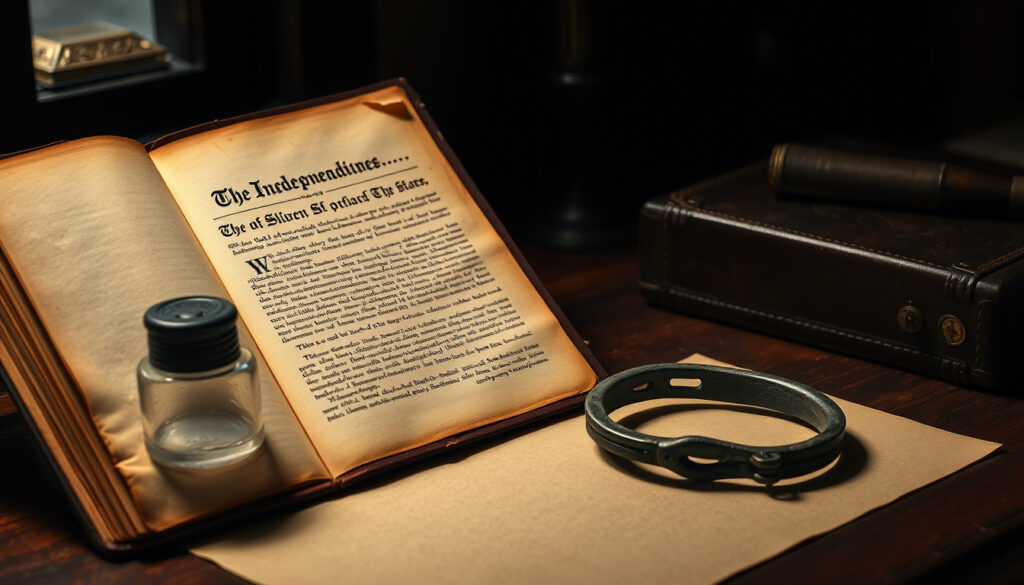
Thomas Jefferson: Biography, Slavery, Quotes, and Legacy
Most Americans know Thomas Jefferson as the man who wrote “all men are created equal.” But the same hand that drafted those words also held the ownership papers for hundreds of enslaved people. That tension—between soaring ideals and daily reality—runs through every phase of his life, from Monticello to the White House, and it still forces us to ask what we make of a founding father who embodied the very contradictions he helped build.
Born: April 13, 1743 ·
Presidency: 1801–1809 ·
Primary authorship: Declaration of Independence ·
Enslaved people at Monticello: over 600 ·
Age at death: 83 ·
Vice president under: John Adams
Quick snapshot
- Primary author of the Declaration of Independence (National Archives)
- Third president of the United States (1801–1809) (Britannica)
- Enslaved over 600 people at Monticello (Study.com)
- Exact religious beliefs—especially his view of Jesus’ divinity (Britannica)
- Precise number of children he fathered with Sally Hemings (CBS News via YouTube)
- His final spoken words—reportedly “Is it the Fourth?” (Britannica)
- 1743: Born in Shadwell, Virginia (Britannica)
- 1776: Drafted the Declaration of Independence (National Archives)
- 1801–1809: Third US president (Study.com)
- Ongoing archaeological work at Monticello continues to reveal enslaved lives (Britannica)
- DNA analysis from 1998 remains the basis for paternity conclusions (CBS News via YouTube)
Six key facts in one pattern: Jefferson’s public roles were monumental, but his private life was deeply entangled with the institution he publicly condemned.
| Label | Value |
|---|---|
| Full name | Thomas Jefferson |
| Birth | April 13, 1743, Shadwell, Virginia (Study.com) |
| Death | July 4, 1826, Monticello, Virginia (Study.com) |
| Presidency | March 4, 1801 – March 4, 1809 (Britannica) |
| Party | Democratic-Republican (Britannica) |
| Notable document | Declaration of Independence (National Archives) |
What was Thomas Jefferson most famous for?
Drafting the Declaration of Independence
Jefferson is best known as the primary author of the Declaration of Independence, adopted on July 4, 1776. The document’s opening lines—”We hold these truths to be self-evident, that all men are created equal”—became the moral backbone of the American Revolution and a global touchstone for human rights (National Archives).
Founding Father role
Beyond the Declaration, Jefferson served as the first Secretary of State under George Washington and the second vice president under John Adams. He later became the third president of the United States, guiding the nation through the Louisiana Purchase in 1803 (Study.com).
Third US president
His presidency (1801–1809) is noted for expanding the country westward, reducing the national debt, and reinforcing the separation of church and state. He also founded the University of Virginia in 1819 (Britannica).
Jefferson’s fame rests on a stack of documents and institutions that outlast him. Yet his most famous words collided with his personal choices—a collision that modern readers can’t ignore.
The implication: his greatest achievements remain inseparable from his deepest failures.
What did Jefferson say about slavery?
Jefferson’s writings on slavery
In his 1785 book Notes on the State of Virginia, Jefferson called slavery a “moral depravity” and warned that failing to end it would bring “convulsions” that could destroy the republic. He proposed gradual emancipation and a ban on slavery in western territories (Rice Magazine).
Monticello enslaved population
Despite those words, Jefferson enslaved about 600 people over his lifetime. At Monticello, enslaved laborers worked in fields, workshops, and the mansion. He freed only seven individuals while he lived (CBS News via YouTube).
Contradiction between ideals and practice
Historians point to several reasons for the gap: Jefferson inherited large debts alongside enslaved people, Virginia law made manumission difficult after 1792, and he personally believed immediate emancipation would lead to racial violence. He also advocated colonization—the removal of freed Black people to Africa or the West Indies (Rice Magazine).
Jefferson condemned slavery in the abstract while profiting from it daily. The moral clarity of his words never matched the messiness of his plantation ledger.
The pattern: every argument he made against slavery was contradicted by the life he lived.
What did Jefferson say before he died?
According to historical accounts, Jefferson died on July 4, 1826—the 50th anniversary of the Declaration—at Monticello. His reported last words were “Is it the Fourth?” or “Is it the Fourth of July?” He died at about 1:00 p.m., hours after learning that the day had indeed arrived. John Adams, his political rival and friend, died the same day, reportedly saying “Thomas Jefferson still survives” unaware that Jefferson had already passed (CBS News via YouTube).
What this means: even his death was wrapped in the mythic timing of the nation’s founding.
What did Thomas Jefferson say about Jesus?
The Jefferson Bible
Jefferson compiled a version of the New Testament that stripped out all references to miracles, angels, and the resurrection. He called it “The Life and Morals of Jesus of Nazareth” and considered it the truest moral philosophy (Britannica).
Views on miracles
Jefferson rejected the divinity of Jesus and believed that the authentic teachings of Jesus were corrupted by the early church. He saw Jesus as a great moral teacher, not the son of God (Britannica).
Separation of church and state
As president, Jefferson wrote of “a wall of separation between Church and State” in an 1802 letter to the Danbury Baptists. This phrase defined American religious liberty (Britannica).
The catch: his private faith was far more radical than his public statements suggested.
Which president fathered a child at 70?
Sally Hemings children
Jefferson fathered at least six children with Sally Hemings, an enslaved woman at Monticello. Hemings was also the half-sister of Jefferson’s deceased wife, Martha Wayles Skelton. The children—Beverly, Harriet, Madison, Eston, and two who died in infancy—were born between 1795 and 1808 (CBS News via YouTube).
DNA evidence
In 1998, a DNA study compared Y-chromosome markers from Jefferson’s male-line descendants with those from Hemings’s last son. The results matched, confirming that Jefferson—or a Jefferson male with the same Y-chromosome—was the father (CBS News via YouTube).
Historical debate
Before the DNA results, some historians argued that Jefferson’s nephews or other relatives fathered Hemings’s children. The 1998 study largely ended the mainstream debate, though a few dissenters remain (Study.com).
The implication: the scientific evidence cemented what many had long suspected about Jefferson’s private life.
What did JFK say about Jefferson?
At a White House dinner in 1962 honoring Nobel Prize winners, President John F. Kennedy remarked: “I think this is the most extraordinary collection of talent, of human knowledge, that has ever been gathered together at the White House, with the possible exception of when Thomas Jefferson dined alone.” The line underscored Jefferson’s reputation as a polymath and intellectual model (Britannica).
The pattern: even his admirers framed him as a singular figure, set apart from ordinary achievement.
What happened to Sally Hemings after Jefferson died?
Hemings’ life after Monticello
After Jefferson’s death in 1826, Sally Hemings remained at Monticello for about two years. She was then freed by Jefferson’s daughter Martha Jefferson Randolph—not through Jefferson’s will, which freed only a handful of enslaved people (Britannica).
Freedom and family
Hemings moved to Charlottesville, Virginia, where she lived with her sons Madison and Eston until her death in 1835. Her descendants maintain an active community and have been central to the Monticello site’s efforts to tell a fuller history (Monticello).
Descendant community
Today, the Thomas Jefferson Foundation at Monticello includes Hemings descendants in its board and programming. The site’s “Slavery at Monticello” tour emphasizes the lives of the enslaved, including Hemings (Monticello).
What this means: the story of Jefferson’s enslaved family is now an integral part of how his legacy is understood.
Timeline
- 1743: Born in Shadwell, Virginia (Britannica)
- 1776: Drafted the Declaration of Independence (National Archives)
- 1801–1809: Third President of the United States (Study.com)
- 1803: Louisiana Purchase (Britannica)
- 1826: Died on July 4, same day as John Adams (CBS News via YouTube)
What we know — and what we don’t
Confirmed facts
- Jefferson was primary author of the Declaration of Independence (National Archives)
- He owned over 600 enslaved people (Study.com)
- DNA evidence confirms he fathered children with Sally Hemings (CBS News via YouTube)
Unclear or debated
- Exact nature of Jefferson’s religious beliefs—his private view of Jesus’ divinity remains ambiguous (Britannica)
- Precise number of children with Hemings—historical records are incomplete (CBS News via YouTube)
- His final spoken words—the “Is it the Fourth?” account is disputed (Britannica)
Perspectives on Jefferson
I tremble for my country when I reflect that God is just: that his justice cannot sleep forever.
— Thomas Jefferson, Notes on the State of Virginia (1785) (Rice Magazine)
I think this is the most extraordinary collection of talent, of human knowledge, that has ever been gathered together at the White House, with the possible exception of when Thomas Jefferson dined alone.
— President John F. Kennedy, at a White House dinner for Nobel laureates (1962) (Britannica)
Is it the Fourth?
— Reported last words of Thomas Jefferson (July 4, 1826) (CBS News via YouTube)
For Americans continuing to wrestle with the legacy of slavery, Jefferson remains the most vivid example of the gap between principle and practice. The choice is not to cancel or canonize, but to hold both truths together: the author of liberty and the architect of bondage. How we teach, memorialize, and reckon with that contradiction will shape the next generation’s understanding of what it means to be free.
Explore other complex biographies: Warren Buffett: Biography, Investment Strategy, and Key Facts and James Gunn: From Marvel to DC – Career and Personal Life.
Frequently asked questions
What was Thomas Jefferson’s greatest achievement?
Most historians consider his authorship of the Declaration of Independence his greatest achievement (National Archives).
Did Thomas Jefferson really write the Declaration of Independence alone?
He was the principal author, but the document was edited by the Committee of Five (John Adams, Benjamin Franklin, Roger Sherman, Robert Livingston) and then by the Continental Congress (National Archives).
How many slaves did Thomas Jefferson own?
He enslaved about 600 people over his lifetime (Study.com).
What did Thomas Jefferson think about religion?
He believed in a creator but rejected the divinity of Jesus, compiling his own version of the New Testament that removed miracles (Britannica).
Who were Thomas Jefferson’s children?
He had six known children with his wife Martha, but only two survived to adulthood. He also fathered at least six children with Sally Hemings (CBS News via YouTube).
How did Thomas Jefferson die?
He died of natural causes (likely uremia or pneumonia) on July 4, 1826, at Monticello (Britannica).
What is the Jefferson Bible?
It is Jefferson’s personal compilation of the New Testament, titled “The Life and Morals of Jesus of Nazareth,” which excluded miracles and the resurrection (Britannica).
Was Thomas Jefferson a good president?
Presidential rankings typically place him in the top tier for his Louisiana Purchase and debt reduction, but his record on slavery is heavily criticized (Study.com).
More related posts
 Majestic Elegance Punta Cana: Reviews, Status & Tips
 Is Cucumber a Fruit – Botanical vs Culinary Truth
 Shoppers Drug Mart Vancouver: Locations & Boycott
 Air India Plane Crash Report: Cause, Survivor & Death Toll
 Elder Scrolls Oblivion Remake: Release, Worth It & More
 Carbon Tax Rebate Payment Dates 2026: Canada Schedule
 Matthew Tkachuk: Salary, Nationality, Wife & Family Facts
