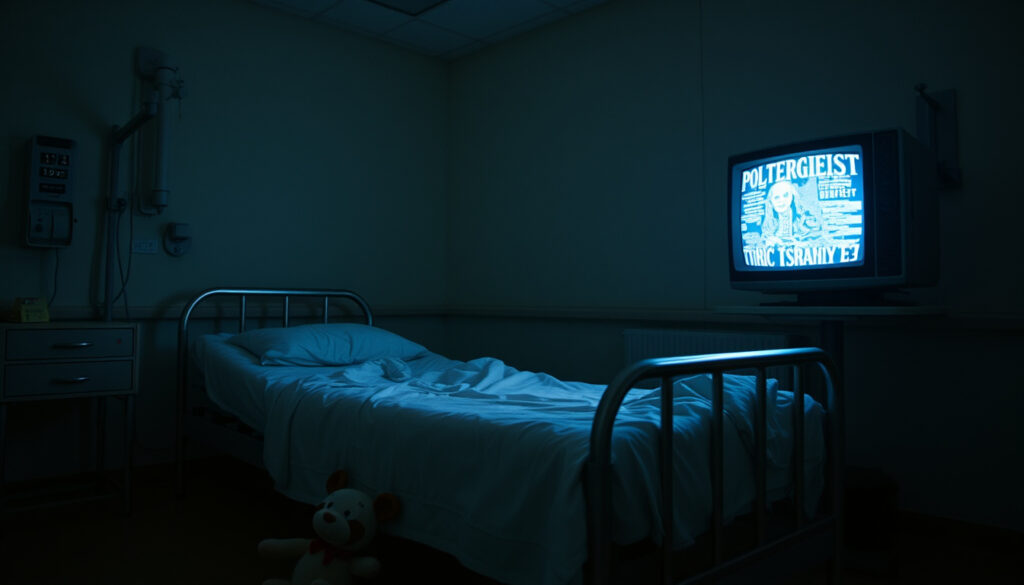
Heather O’Rourke: Cause of Death, Illness, and Poltergeist Myth
For anyone who grew up in the 1980s, the image of Carol Anne Freeling staring into a static-filled TV is unforgettable, but Heather O’Rourke’s own life ended far too soon from a congenital bowel condition misdiagnosed as Crohn’s disease, fueling the Poltergeist curse myth that caused real pain for her family. This article separates the verified medical record from the myth using autopsy reports and contemporary interviews.
Born: December 27, 1975 · Died: February 1, 1988 (age 12) · Known for: Carol Anne Freeling in Poltergeist · Cause of death: Cardiac arrest due to septic shock from bowel obstruction · Illness: Misdiagnosed Crohn’s disease, later found congenital stenosis of the bowel
Quick snapshot
- Heather O’Rourke died on February 1, 1988 at age 12 in San Diego, California (Wikipedia (online encyclopedia))
- Cause of death: cardiopulmonary arrest due to septic shock from congenital stenosis of the intestine (All That’s Interesting (history and culture website))
- She was misdiagnosed with Crohn’s disease in 1987 (All That’s Interesting (history and culture website))
- She died during emergency surgery for a bowel obstruction (Biography.com (biographic reference))
- The exact sequence of symptoms before hospitalization on January 31, 1988 — initial reports suggested flu-like illness (Facebook group (social media post, contemporaneous report))
- Whether any earlier signs of intestinal stenosis were missed by doctors
- The precise wording of the hospital spokesman’s statement
- Late 1987: Misdiagnosed with Crohn’s disease (All That’s Interesting)
- January 31, 1988: Becomes ill, collapses at home, airlifted to Children’s Hospital of San Diego (Wikipedia)
- February 1, 1988: Emergency surgery for bowel obstruction; suffers two cardiac arrests; pronounced dead at 2:43 PM (Wikipedia)
- June 1988: Poltergeist III released posthumously (Biography.com)
- Continued fascination with the Poltergeist curse myth, despite family members expressing hurt over the rumors (People (celebrity news magazine))
- Her legacy as the iconic Carol Anne remains a benchmark of 1980s horror cinema
Here are the key facts about Heather O’Rourke’s life and death.
| Fact | Detail |
|---|---|
| Full name | Heather Michele O’Rourke |
| Born | December 27, 1975, San Diego, California, U.S. |
| Died | February 1, 1988, San Diego, California (age 12) |
| Cause of death | Cardiac arrest due to septic shock from congenital bowel stenosis (Wikipedia (online encyclopedia)) |
| Initial misdiagnosis | Celiac disease (1987) — later attributed to Crohn’s disease (All That’s Interesting (history and culture website)) |
| Actual condition | Congenital stenosis of the intestine (present from birth, undetected) |
| Occupation | Actress |
| Known for | Carol Anne Freeling in the Poltergeist trilogy |
| Last film | Poltergeist III (released June 1988, four months after her death) (Biography.com (biographic reference)) |
| Role in franchise | Main child protagonist across all three films |
What was Heather O’Rourke’s illness?
The misdiagnosis: Crohn’s disease (1987)
- Chronology: According to All That’s Interesting (history and culture website), Heather O’Rourke was initially diagnosed with Crohn’s disease in 1987 after experiencing persistent gastrointestinal symptoms.
- Incorrect assumption: Crohn’s is a chronic inflammatory bowel disease. Because the symptoms — vomiting, weight loss, abdominal pain — overlapped with many conditions, doctors treated her for Crohn’s without further imaging.
- Source of error: The congenital stenosis (narrowing) of the intestine mimics the obstructive symptoms of Crohn’s, leading to a mistaken clinical picture.
Bottom line: Heather O’Rourke’s Crohn’s diagnosis was a clinical judgment that turned out to be wrong; the actual blockage was mechanical, not inflammatory.
The actual condition: intestinal stenosis
- Definition: Intestinal stenosis is an abnormal narrowing of the bowel lumen, present from birth. In Heather’s case, it went undetected for 12 years.
- Complication: Partial obstructions may have been present for years, but in late January 1988 a complete blockage occurred, leading to vomiting, inability to eat, and rapid deterioration.
- Official cause: The San Diego County coroner ruled that cardiopulmonary arrest due to septic shock from the bowel obstruction was the immediate cause of death (Facebook group (social media post, contemporaneous report)).
The catch: A congenital condition that might have been detected with routine imaging was mistaken for a manageable chronic disease, with fatal consequences.
The final illness (January 31 – February 1, 1988)
- Onset: According to Wikipedia (online encyclopedia), on January 31, 1988, Heather became acutely ill, vomiting and unable to hold down food or fluids.
- Emergency response: She collapsed at her home in San Diego, was airlifted to Children’s Hospital of San Diego, and doctors found an acute bowel obstruction.
- Surgery and arrest: Emergency surgery was performed to correct the obstruction. She suffered two cardiac arrests and was pronounced dead at 2:43 p.m. (CPR lasting more than 30 minutes).
For families of children with recurrent abdominal pain: the lesson is clear — when symptoms persist despite treatment for Crohn’s, request imaging to rule out structural causes. A simple CT scan might have changed the outcome.
The implication: A correct early diagnosis could have saved Heather O’Rourke’s life.
How did Heather O’Rourke die?
Emergency timeline
| Time | Event |
|---|---|
| Late January 31, 1988 | Heather begins vomiting, cannot eat or drink |
| Early February 1, 1988 | Collapses at home, family calls 911 |
| Mid-morning | Airlifted to Children’s Hospital of San Diego |
| Late morning | Surgeons discover acute bowel obstruction due to congenital stenosis |
| Afternoon | Emergency surgery; first cardiac arrest |
| 2:43 p.m. | Pronounced dead after second cardiac arrest, despite prolonged CPR |
According to Wikipedia (online encyclopedia), the coroner confirmed on February 3, 1988 that the cause was septic shock stemming from the intestinal stenosis.
Bottom line: Heather O’Rourke’s death was a tragedy of misdiagnosis, not supernatural forces. A congenital narrowing of the bowel, undetected since birth, finally occluded and caused a fatal infection.
What this means: The medical response, though swift, could not overcome the undetected structural flaw.
What is the Poltergeist curse?
The legend
According to Biography.com (biographic reference), the so-called “Poltergeist curse” emerged after several actors connected to the Poltergeist film series died unexpectedly. The narrative often cites:
- Dominique Dunne (Dana Freeling) — murdered by her ex-boyfriend in 1982, after completing the first film
- Julian Beck (Kane) — died of stomach cancer in 1985, after filming Poltergeist II
- Will Sampson (Taylor) — died in 1987 from complications after a heart-lung transplant
- Heather O’Rourke — died in 1988 from the bowel condition
The pattern led to rumors that the set was haunted or that using real human skeletons in Poltergeist (1982) brought a curse.
What the facts show
- No causal link: None of these deaths were related to each other or to the film’s production. Dunne’s murder was a domestic violence tragedy; Beck’s cancer was pre-existing; Sampson’s surgery complications were unrelated.
- Family impact: People (celebrity news magazine) reported in 2026 that Heather’s family and surviving castmates were hurt by the persistent curse rumors, calling them disrespectful to her memory.
The implication: The curse is a narrative created by the media and perpetuated by coincidence, not a genuine supernatural phenomenon.
Bottom line: Heather O’Rourke’s family has called the curse myth hurtful; the deaths are separate tragedies, not supernatural events.
The pattern: Coincidence, not conspiracy, explains the untimely losses.
Timeline of key events
- December 27, 1975 — Heather O’Rourke born in San Diego, California
- 1981 — Cast as Carol Anne Freeling in Poltergeist (released 1982)
- 1986 — Stars in Poltergeist II: The Other Side
- 1987 — Misdiagnosed with Crohn’s disease
- June 1987 — Poltergeist III begins filming; completed late 1987
- January 31, 1988 — Heather becomes critically ill
- February 1, 1988 — Dies after emergency surgery
- June 10, 1988 — Poltergeist III released posthumously
- 2002–present — Continued media coverage of the “curse” legend
For Heather O’Rourke, the timeline shows a swift decline that might have been prevented with earlier imaging.
For fans and journalists alike: the ease of assembling a list of deaths and attaching a label distracts from the real stories — a murdered young actress, a child who died from a treatable condition that was misdiagnosed. The curse narrative erases the individual tragedies.
Clarity: Separating fact from rumor
Confirmed facts
- Heather O’Rourke died at age 12 on February 1, 1988 (Wikipedia (online encyclopedia))
- Death was caused by septic shock due to congenital intestinal stenosis (Wikipedia (online encyclopedia))
- She was misdiagnosed with Crohn’s disease in 1987 (All That’s Interesting (history and culture website))
- She suffered two cardiac arrests before being pronounced dead (Wikipedia (online encyclopedia))
- Poltergeist III was released four months after her death (Biography.com (biographic reference))
- Family and costars have expressed being hurt by curse rumors (People (celebrity news magazine))
What’s unclear
- Whether her doctors ever considered imaging for congenital anomalies
- The exact timeline of the misdiagnosis: some sources say “Crohn’s,” others say “celiac disease” initially
- The precise content of the hospital spokesman’s statement (reported as “she died during surgery”)
- Whether the “flu-like symptoms” reported before collapse were actually early signs of the obstruction
The lesson: Even with confirmed facts, gaps remain that fuel speculation.
Quotes from the record
“She died during surgery to repair an acute bowel obstruction caused by congenital stenosis of the intestine.”
— A hospital spokesman, quoted in contemporaneous news reports (Facebook group archive)
“The cause of death is cardiopulmonary arrest and intestinal stenosis.”
— San Diego County coroner’s office, as recorded in coroner’s statement (Facebook group archive)
For the millions who grew up with Carol Anne’s voice echoing from a static TV, the real story is not a curse — it’s a reminder that the most frightening things are not ghosts, but the failures of medical certainty. For researchers, historians, and the O’Rourke family, the choice is clear: remember the little girl behind the performance, not the legend built from her death. For Heather O’Rourke, the truth of her medical misdiagnosis stands as a cautionary tale that demands careful diagnosis and a compassionate memory.
en.wikipedia.org, facebook.com, youtube.com, people.com, allthatsinteresting.com, reddit.com, facebook.com, open.spotify.com, biography.com, imdb.com, instagram.com, complex.com
For readers seeking a deeper dive into the medical facts and myths surrounding her tragic passing, Heather ORourkes real cause of death provides a well-researched breakdown.
Frequently asked questions
How many of the actors in Poltergeist have died?
Four principal actors died either during or soon after the trilogy: Dominique Dunne (1982), Julian Beck (1985), Will Sampson (1987), and Heather O’Rourke (1988). Their causes of death range from murder to cancer to surgical complications — none related to each other or the production.
What happened while filming Poltergeist?
There were no reported on-set accidents or fatalities. The “curse” legend was built entirely from deaths that occurred years after filming. The only notable event was the use of real human skeletons as props, which later fueled superstition.
How old would Heather O’Rourke be today?
Born on December 27, 1975, she would be 49 years old as of 2025.
What was Heather O’Rourke’s last film?
Her final film was Poltergeist III, released in June 1988 — four months after her death.
Did the Poltergeist curse affect other cast members?
No credible evidence links any of the deaths to a curse. The deaths occurred independently over several years and from very different medical and violent causes. The narrative is post-hoc and has been dispelled by factual reporting.
More related posts
 Nina Drama: Biography, Career, and Relationship Facts
 Michelle Monaghan Movies and TV Shows: Full Filmography
 Freddie Mercury Biography: Nationality, Lovers, and Legacy
 External Hemorrhoids in Females: Symptoms, Causes & Treatment
 Brett Favre: Parkinson’s, Welfare Case, and Taylor Swift Comment
 Blue Jays World Series: Wins, History & Championships
 Fetes des Meres 2025 – Date, History and Traditions in France
